Rigadoon

Rigadoon

Louis-Ferdinand Celine

Louis-Ferdinand Celine

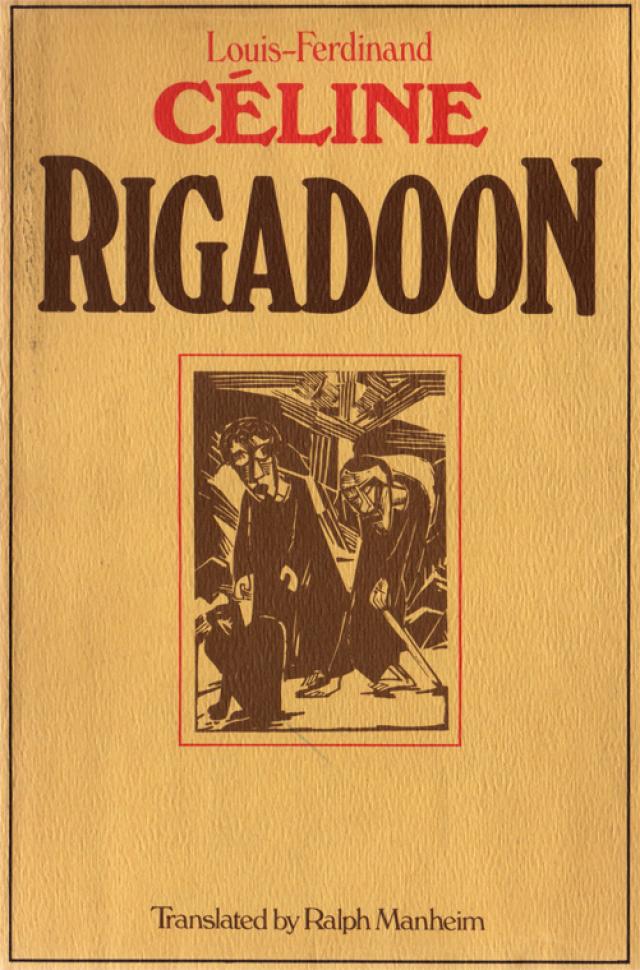
ReviewCéline quite deliberately makes us feel the inescapable, mind-rotting horror of endless chaos, the fact of war as Americans have never known it. (_Washington Post Book World_ ) Céline's explosive language and style is the very sign of his experience: its full impact explodes, as if by delayed reaction, before the eyes, and in the consciousness, of author, narrator, and reader alike. (_Times Literary Supplement_ ) Lit with a flash of frighteningly lucid prophecy, and seen to be nothing less than the doom of the human race. . . . But what is oddest of all about Rigadoon, and what distinguishes it from Céline's other work, is its sense of peace, almost of consummation, at the sight of a Europe in rubble and flames. (_The New York Times Book Review_ ) More than most modern authors, [Céline is] able to plunge directly into the burning center, where Europe, in rage and anguish, is tearing itself apart. In so doing, he captures the heat and energy of he final holocaust better than almost anyone. (_The Nation_ ) Manheim’s translation succeeds in capturing the powerful immediacy of Céline’s prose. (_Library Journal_ ) Product DescriptionCompleted right before his death in 1961, Rigadoon, the most compassionate of Céline's novels, explores the ravages of war and its aftermath.Often comic and always angry, the first-person autobiographical narrator, with his wife and their cat in tow, takes the reader with him on his flight from Paris to Denmark after finding himself on the losing side of World War II. The train rides that encompass the novel are filled with madness and mercy, as Céline, a physician, aids refugees while ignoring his own medical needs. Céline's inventive style and black humor profoundly influenced many writers who came after him, including Kurt Vonnegut, Jack Kerouac, William Burroughs, Allen Ginsberg and Charles Bukowski. As Kurt Vonnegut states in his introduction to this edition, "[Céline] demonstrated that perhaps half of all experience, the animal half, had been concealed by good manners. No honest writer or speaker will ever want to be polite again."
Read online
  • 57
Guignol's Band

Guignol's Band

Louis-Ferdinand Celine

Louis-Ferdinand Celine

Celine's third novel, first published in 1944 but dealing with events taking place during the First World War, Guignol's Band follows the narrator's meanderings through London after he has been demobilized due to a war injury. The result is a frank, uncompromising, yet grotesquely funny portrayal of the English capital's seedy underworld, peopled by prostitutes, pimps and schemers.
Read online
  • 55
Death on Credit

Death on Credit

Louis-Ferdinand Celine

Louis-Ferdinand Celine

When Celine's first novel, Journey to the End of the Night was first published in 1932, it created an instant scandal, being extravagantly praised by its supporters and savagely attacked by its horrified opponents. Four years later came the sequel, Death on Credit. Both were a new kind of novel, frank about the author's thoughts and actions in ways that readers had never encountered, ultra-realistic - and full of incidents that could not possibly be true to life - and characters that stretched the imagination.In Death on Credit, Ferdinand Bardamu, Celine's alter ego, is a doctor in Paris, treating the poor who seldom pay him but who take every advantage of his availability. The action is not continuous but goes back in time to earlier memories and often moves into fantasy, especially in Bardamu's sexual escapades; the style becomes deliberately rougher and sentences disintegrate to catch the flavour of the teeming world of everyday Parisian tragedies, the struggle to make a...
Read online
  • 54
North

North

Louis-Ferdinand Celine

Louis-Ferdinand Celine

SUMMARY:Accompanied by his wife, their cat, and an actor friend, ourautobiographical narrator Ferdinand leaves Paris for Baden-Baden (aWorld War II hideaway for wealthy Germans), is then sent to abombed-out Berlin, and finally leaves for Denmark in search of the goldhe had stashed there prior to the war. With the Third Reich in ruinsand the Allied armies on Ferdinand's heels, North combines documentary realism with hallucinatory images, capturing the chaos of war and its toll on both victim and victimizer.
Read online
  • 50
London Bridge

London Bridge

Louis-Ferdinand Celine

Louis-Ferdinand Celine

A major work by one of France's most important authors of the twentieth century, London Bridge is a riotous novel about the London underworld during the First World War. Picking up where its predecessor Guignol's Band left off, Celine's narrator recounts his disastrous partnership with an eccentric Frenchman intent on financing a trip to Tibet by winning a gas-mask competition; his uneasy relationship with London's pimps and whores and their common nemesis, Inspector Matthew of Scotland Yard; and, most scandalous of all, his affair with a colonel's daughter.
Read online
  • 50
Journey to the End of the Night

Journey to the End of the Night

Louis-Ferdinand Celine

Louis-Ferdinand Celine

The dark side of On the Road: instead of seeking kicks, the French narrator travels the globe to find an ever deeper disgust for life.Louis-Ferdinand Celine's revulsion and anger at what he considered the idiocy and hypocrisy of society explodes from nearly every page of this novel. Filled with slang and obscenities and written in raw, colloquial language, Journey to the End of the Night is a literary symphony of violence, cruelty and obscene nihilism. This book shocked most critics when it was first published in France in 1932, but quickly became a success with the reading public in Europe, and later in America where it was first published by New Directions in 1952. The story of the improbable yet convincingly described travels of the petit-bourgeois (and largely autobiographical) antihero, Bardamu, from the trenches of World War I, to the African jungle, to New York and Detroit, and finally to life as a failed doctor in Paris, takes the readers by the scruff and hurtles them toward the novel's inevitable, sad conclusion.Amazon.com ReviewWhen it was published in 1932, this then-shocking and revolutionary first fiction redefined the art of the novel with its black humor, its nihilism, and its irreverent, explosive writing style, and made Louis-Ferdinand Celine one of France's--and literature's--most important 20th-Century writers. The picaresque adventures of Bardamu, the sarcastic and brilliant antihero of Journey to the End of the Night move from the battlefields of World War I (complete with buffoonish officers and cowardly soldiers), to French West Africa, the United States, and back to France in a style of prose that's lyrical, hallucinatory, and hilariously scathing toward nearly everybody and everything. Yet, beneath it all one can detect a gentle core of idealism. Review'My favourite French classic has to be Journey to the End of the Night by Louis-Ferdinand Celine. It's an epic that takes you all around the world, but the centre of the world is Paris, or Celine's delirious, slightly hallucinatory, incredibly poetic vision of it.' Andrew Hussey, The Guardian
Read online
  • 45
Death on the Installment Plan

Death on the Installment Plan

Louis-Ferdinand Celine

Louis-Ferdinand Celine

Death on the Installment Plan is a companion volume to Louis-Ferinand Céline's earlier novel Journey to the End of Night. Published in rapid succession in the middle 1930s, these two books shocked European literatue and world consciousness. Nominally fiction but more rightly called "creative confessions," they told of the author's childhood in excoriating Paris slums, of serves in the mud wastes of World War I and African jungles. Mixing unmitigated despair with Gargantuan comedy, they also created a new style, in which invective and obscenity were laced with phrases of unforgettable poetry. Céline's influence revolutionized the contemporary approach to fiction. Under a cloud for a period, his work is now acknowledged as the forerunner of today's "black humor."Louis-Ferdinand Celine's second novel continues the style of black humor and the delirious but immediate prose that made the author instantly famous in his native France in the aftermath of World War I. Celine's goal was to create a kind of literature that described people in honest terms, unembellished by the conventions of fiction, no matter how mean and crummy they were, and to portray them in the real language of everyday life and thought. He succeeds darkly and brilliantly in Death on the Installment Plan, yet it is also a sweet kind of book, a young boy's coming-of-age tale, struggling with his parents and looking for his own kind of personal freedom.
Read online
  • 42
183