Distances, p.1
Distances, page 1


Conversation Pieces
A Small Paperback Series from Aqueduct Press
1. The Grand Conversation
Essays by L. Timmel Duchamp
2. With Her Body
Short Fiction by Nicola Griffith
3. Changeling
A Novella by Nancy Jane Moore
4. Counting on Wildflowers
An Entanglement by Kim Antieau
5. The Traveling Tide
Short Fiction by Rosaleen Love
6. The Adventures of the Faithful Counselor
A Narrative Poem by Anne Sheldon
7. Ordinary People
A Collection by Eleanor Arnason
8. Writing the Other: A Practical Approach
by Nisi Shawl & Cynthia Ward
9. Alien Bootlegger
A Novella by Rebecca Ore
10. The Red Rose Rages (Bleeding)
A Short Novel by L. Timmel Duchamp
11. Talking Back
Epistolary Fantasies
edited by L. Timmel Duchamp
12. Absolute Uncertainty
Short Fiction by Lucy Sussex
13. Candle in a Bottle
A Novella by Carolyn Ives Gilman
14. Knots
Short Fiction by Wendy Walker
15. Naomi Mitchison: A Profile of Her Life and Work
A Monograph by Lesley A. Hall
16. We, Robots
A Novella by Sue Lange
17. Making Love in Madrid
A Novella by Kimberly Todd Wade
18. Of Love and Other Monsters
A Novella by Vandana Singh
19. Aliens of the Heart
Short Fiction by Carolyn Ives Gilman
20. Voices From Fairyland:
The Fantastical Poems of Mary Coleridge, Charlotte Mew, and Sylvia Townsend Warner
Edited and With Poems by Theodora Goss
21. My Death
A Novella by Lisa Tuttle
22. De Secretis Mulierum
A Novella by L. Timmel Duchamp
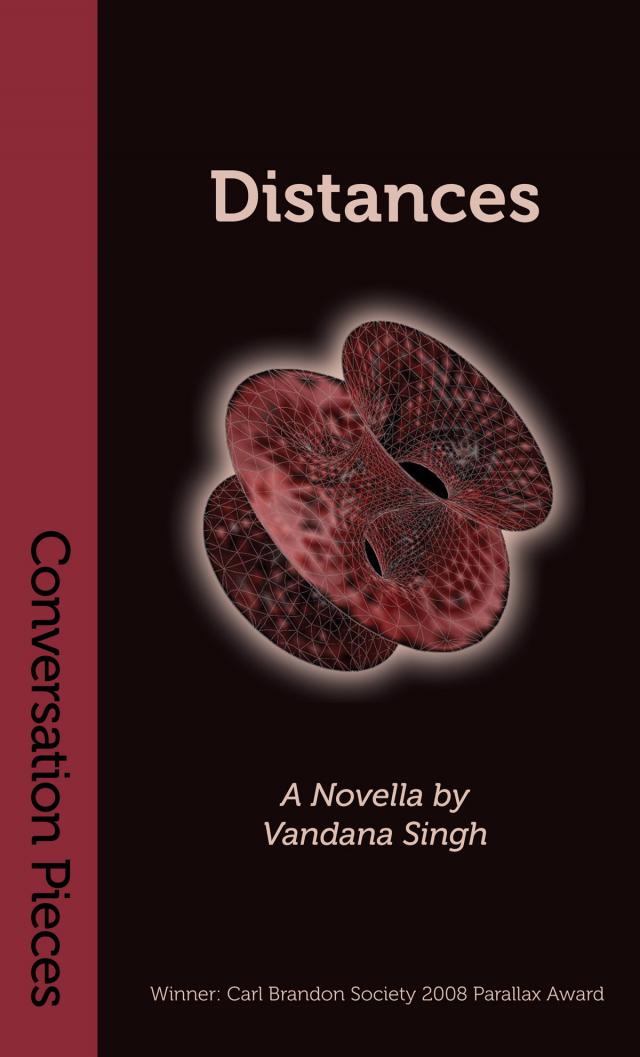
23. Distances
A Novella by Vandana Singh
24. Three Observations and a Dialogue:
Round and About SF
Essays by Sylvia Kelso and a correspondence
with Lois McMaster Bujold
25. The Buonarotti Quartet
Short Fiction by Gwyneth Jones
26. Slightly Behind and to the Left
Four Stories & Three Drabbles
by Claire Light
27. Through the Drowsy Dark
Short Fiction and Poetry
by Rachel Swirsky
28. Shotgun Lullabies
Stories and Poems by Sheree Renée Thomas
29. A Brood of Foxes
A Novella by Kristin Livdahl
About the Aqueduct Press
Conversation Pieces Series
The feminist engaged with sf is passionately interested in challenging the way things are, passionately determined to understand how everything works. It is my constant sense of our feminist-sf present as a grand conversation that enables me to trace its existence into the past and from there see its trajectory extending into our future. A genealogy for feminist sf would not constitute a chart depicting direct lineages but would offer us an ever-shifting, fluid mosaic, the individual tiles of which we will probably only ever partially access. What could be more in the spirit of feminist sf than to conceptualize a genealogy that explicitly manifests our own communities across not only space but also time?
Aqueduct’s small paperback series, Conversation Pieces, aims to both document and facilitate the “grand conversation.” The Conversation Pieces series presents a wide variety of texts, including short fiction (which may not always be sf and may not necessarily even be feminist), essays, speeches, manifestoes, poetry, interviews, correspondence, and group discussions. Many of the texts are reprinted material, but some are new. The grand conversation reaches at least as far back as Mary Shelley and extends, in our speculations and visions, into the continually-created future. In Jonathan Goldberg’s words, “To look forward to the history that will be, one must look at and retell the history that has been told.” And that is what Conversation Pieces is all about.
L. Timmel Duchamp
Jonathan Goldberg, “The History That Will Be” in Louise Fradenburg and Carla Freccero, eds., Premodern Sexualities (New York and London: Routledge, 1996)
Published by Aqueduct Press
PO Box 95787
Seattle, WA 98145-2787
www.aqueductpress.com
This book is fiction. Names, characters, businesses, organizations, places, events, and incidents either are the product of the author’s imagination or are used fictitiously. Any resemblance to actual persons, living or dead, events, or locales is entirely coincidental.
Print Copyright © 2009 by Vandana Singh
Digital Copyright © 2011 by Vandana Singh
Digital ISBN: 978-1-933500-62-1
Book Design by Kathryn Wilham
Original Block Print of Mary Shelley by Justin Kempton:
www.writersmugs.com
Front cover illustration by Thomas E. Duchamp
Acknowledgments
This story was written in my usual way: through the writing of a random sentence to find out where it led. That original first sentence is long lost but it led me farther afield, perhaps, than any other place I have been.
I would like to thank my husband Christopher for patiently wading through three drafts of the manuscript and for much-needed encouragement. My gratitude also goes out to my parents-in-law, Melanie and Russ, for their critical and enthusiastic reading of the manuscript. I am indebted to the members of the Cambridge Speculative Fiction Workshop for their intelligent and sometimes ruthless feedback on the second draft. In particular, I thank Jim Kelly for his invaluable comments on the second draft, and for generous encouragement.
I am deeply grateful for the enormous help I received from my publishers at Aqueduct. I thank Timmi Duchamp for immediately getting what my story was about, for helping me look deeper into it, and for her critical enthusiasm and support whenever I needed it. My thanks go out also to Kath Wilham for her patience and attention; specifically for her fine-tooth-comb reading of the text, the catching of little errors and inconsistencies, and for rendering the whole thing into its final, readable form. To Tom Duchamp I’m eternally obliged for a wonderful mini-crash-course on differential geometry, spread over several telephone conversations. I thank Tom for his generosity and insight. Any errors, omissions or misinterpretations (mathematical or otherwise) that might still lurk in the manuscript are, of course, entirely my responsibility.
For my sister-in-law, Ramaa,
with gratitude and affection.
Conversation Pieces
Volume 23
Distances
A Novella
by
Vandana Singh
Distances
Anasuya walked up the dim hallways of the Temple of Mathematical Arts toward the central atrium, her favorite place of repose. She had been three days in the amnion, and the abrupt return to physical reality always left her feeling disoriented and vaguely claustrophobic. The narrow stone passageways seemed to press in closer; the upward slope made her thighs ache. She felt the full weight of her body, slight though it was, as a new burden. For three days she had been soaring in multiple dimensions — now she was back to crawling across a two-d floor like a little desert roll-bug. But strangest of all was the solid presence of things, the way they were weighted by their physicality. Going up into the light, she had to touch the cold stone walls, pass her fingers over the carvings on the archways, brush the soft tapestries — as though to remember the world again.
But for now the world seemed too much with her, the walls too close. She fought the impulse to run — up the passageway, out of the Temple, into the hard light of the bone-dry City, the desertscape, the empty, waterless sky, where she pictured herself falling to her knees in the sand, the air seeping out of her lungs, the blood drying in her veins. She caught her breath, quickened her footsteps, passed under the frieze of the great god Anhutip and into the atrium.
Here her breathing grew easier. The atrium was the highest point of the hollowed-out mesa that housed the temple; its ceiling arched into a vast, soft darkness, below which mica windows let in the autumnal light. Above her the rays crossed each other, tilting imperceptibly with the movement of the sun. She walked among the tiers of light, the pools of light on the stone floor, among the stone sculptures and holographic illusions, until she reached the center of the atrium. From the ceiling above, which was lost in darkness, a long rope hung, bearing a complex, translucent sculpture in shards of colored glass. It moved slowly to and fro, driven by an invisible mechanism, dappling the atrium with a kaleidoscope of turquoise, mauve, and yellow light. Already she was feeling calmer. She sat down on the circular stone bench below the sculpture. There was a small, bubbling fountain in the space enclosed by the bench, from which she took a handful of glittering water that she splashed over her face and neck-slits. She looked into the tiny pool, where bristle-worms swam in the near-dark, all aglow, and felt the familiar comfort of their presence. She smoothed the thin shift she wore over her slender green body, stretched her legs, raised her arms above her head. As the light washed over her in great, slow waves, she was reminded, inevitably, of Sagara, the distant sea — the underwater caves and cliffs and seaweed forests of her childhood.
She lay in the shifting light, her thoughts w
Her thoughts were interrupted by the arrival of the doorkeeper Amas, who moved through the columns of light and darkness like a nervous fish, his wide, brown face reverent. He held a bowl of steaming tea in one hand, while his other hand fumbled with a small holo. She took the tea.
“Do you know,” Amas said in a conspiratorial whisper, “we have sky people visiting! The Master’s been with them all afternoon.”
Off-world tourists, she thought, probably from the moon-world of Sarakira, or the planet Charak, where there was a large mining colony. Or maybe they were from a trade-ship. Before she could ask what the Master was doing with them, he held out the holo to her, half-apologetically.
“Show me?”
“It is a dance of hyperbolas, Amas,” she said gently. “See? Put your finger against the side, like this. In a moment the hyperbolas will morph. Watch with me.”
It was the sort of mathematical art that the Temple gave to tourists and pilgrims — pretty, but with no subtlety. Amas — some called him Poor Amas, or Slow Amas — watched with awed, round eyes. “Oh,” he said. She knew he didn’t understand her explanations, but he liked to hear her say the words. He gave her a quick, shy, worshipful glance that made her sigh inwardly and left her to her solitude.
After he left she sipped the bitter tea, stretching her bare legs. The soliforms that gave her skin its green, exotic tint opened their microscopic petals to the light. She brushed her long black hair away from her neck and examined a tiny scattering of brown flecks on her shoulder. She had first noticed them four days ago. She thought about her mother Lata’s body, Lata on the reed-raft that had been their home, Lata in the water, sunlight gleaming on her green skin, pointing out to the young Anasuya the mathematical harmonies of the world. Lata had been old then. I can’t remember, she thought, whether Lata had brown spots on her body. As always, thinking about Lata made the old grief come alive again. Her hand shook; she set the bowl of tea beside her on the bench.
A senior acolyte passed by in a swirl of robes, ghost-like among the long rays of light, fractured momentarily by shadow and brightness.
“Have you heard,” he said to her in passing, “we have off-worlders visiting. Not tourists — some kind of official delegation from Tirana! Traveled on a ship for eighteen years to get here. I wonder what they want.”
Before she had time to make sense of this startling piece of news, they were upon her, the Master with the off-world visitors in tow. She stood up and made her salutation, palms crossed on chest. The strangers mimicked her, fumbling the simple gesture. There were eight of them, bare of face, with black, thick hair in elaborate coiffures. They wore bright tunics over close-fitting trousers and jewels hanging from their ears. Standing beside them, it was the Master who looked, at that moment, strange to her gaze, with the jade plate on his left cheek, flush with his brown skin, and a ruby cranial plate with ridges and pleats that glowed in the light.
“An official delegation of mathematicians from the Lattice of Tirana itself!” said the Master sibilantly. There were introductions, voices that echoed through the vast stone hall and were lost; she tried to shape her tongue around unfamiliar syllables, realizing with some incredulity that here were people more foreign than she, people from the stars! Kzoric: largeness, roundness, loud voice, spherical geometries on the outside, including the enormous round bun of hair, but her gaze was prickly, sawtooth. Vishk: small, thin, skulking in the shadows, parabolic stoop of back. Tall Hiroq: long face, almost an ellipse, almost bilateral symmetry, long hands fumbling shyly with a neck-clasp, voice deep and rich, quick, shy blinks, glance a sine wave — smooth, curious, and shy all at once. There were three others whose names she forgot, who remained standing at the back, deferentially. But the person who registered with her most was Nirx, who had an unconscious air of authority, for all she bowed and smiled and looked around with childish wonder. Nirx was small and compact, her hair in a braided bun of pleasing symmetry, her face old and wrinkled in complicated and interesting ways, like river mouths bifurcating, entering a sea. Her gaze was sharp, but with a kindness and a reserve. To Anasuya she was like a two-d projection of a multi-dimensional object — a lot was compressed into what she spoke, the way she looked at Anasuya. A woman of secrets, not immediately decipherable, Anasuya thought.
Nirx held in her hands a crystal bottle filled with an amber fluid.
“…Mathematician Nirx here,” said the Master ponderously, lisping through his terrible teeth, “Mathematician Nirx has discovered a new sthanas — a new geometrical space! One that is complex beyond understanding! She has condensed the poetry of this space into a series of elegant equations. But so far these equations have not been solved, for they are intractable to an unexpected degree. Thus Mathematician Nirx and her team have traveled for years from the planet Tirana to see whether our mathematics can help them.
“It is only right that the Temple of Mathematical Arts, first Temple of Anhutip, who knows all forms and relations, should be chosen for this honor. On all of Sura, there is no place more sacred, more famous, for the solution of mathematical poems. And you…You are our best rider, Anasuya, for all that you are young. I offer you this…this poem, with the hope that you will accept.”
The Master took the bottle of amber fluid from Nirx in his trembling, parchment-like hands and held it out to Anasuya. His humped, twisted body, with the bulbous nose and long-drawn-out face, cast grotesque shadows around him. Under the brilliant crimson skull, his shadowed eyes watched her. She had never been able to read the Master. He was like a carelessly assembled mess of contradictory geometries, all jagged, moody edginess and abrupt changes of behavior; his intensity alternated with apathy and aloofness. But she forgot him as she took the bottle in her hands.
What new sthanas was this? What undiscovered mathematical country lay within?
She felt an anticipatory tingle of excitement. Maybe this was just what she needed.
“I am honored to accept,” she said at last.
“We admire greatly your analog methods of computation,” the Tirani woman Nirx said in a little, piping voice. She spoke the language without hesitation but with a lilting accent that was quite foreign. Her hands fluttered like insects, a pleasing harmony. “We have heard about it from travelers and traders and old records from earlier visitors to Sura. With our scant knowledge of your techniques, we constructed molecules whose interactions mimic the behavior of the new equations. But our reaction vats are crude compared to yours! Nor are the molecules very stable, being tremendously complex — so we must reconfigure the solution every few days from the seed…”
Each mathematical poem had its secret, inner space, its universe, nestled within its equations the way meaning was enclosed by words. That inner space or solution space — the sthanas — was the poem’s regime of validity, the place where the poem came true. Holding the bottle up to the rays of light, Anasuya felt the familiar mixture of anticipation and exhilaration — and a curious switching of realities, as though the external world of people and lovers, the weight of her own incompleteness, her hopeless, endless nostalgia, had lost all definition, and the abstractions of mathematics were once again the things of true substance, tangible, real.
She was a rider like no other. Her function was to lie in an amnion that had been specially constructed for her, with her neck-slits open. The sap that was exuded by the feathery organs inside her neck-slits and by the undersides of her fingernails and the tips of her breasts — the sap her people called vapasjal, that which is given back or returned — contained microscopic organelles the chemists at the temple called spiroforms. The spiroforms tasted the molecules in the mixture; as they interacted with the chemical stew of the amnion, a space blossomed in her mind, the most abstract made-world there could be: the sthanas itself: the solution-space of the mathematics. The tiny, invisible machines that swam in the fluid recorded the chemical changes wrought by the spiroforms and transmitted to the Temple’s data banks a holographic representation of this inner space, brick by proverbial brick. Other holo-riders had to sit directly in front of a display that recorded the chemical reactions in the standard vats, and, through a complex science of interpretation and analysis, including trial and error and constant tinkering, they had to attempt to fill in the solution space of the given mathematics. For Anasuya this process was like a blind person mapping the contours of the world with a stick, and it horrified her because for her mathematics was experiential, a sixth sense that bared before her the harmonies, natural and artificial, that formed the sub-text of the world. Floating in the amnion, she entered unmapped territory; she was a speck, a ship lost in vastness, a rider on waves of maxima and minima, an explorer of a space that, but for her, would remain only guessed at. She entered this mathematical country as an explorer would enter a new land: she looked for singularities, skated over manifolds, sketched out the abstract, mountainous terrain of bizarre mathematical functions; she sought branch points and branch cuts and hidden territories bearing algebraic surprises. She took the esoteric world of the sthanas and made it her reality.