

Authentic, p.1
Authentic, page 1


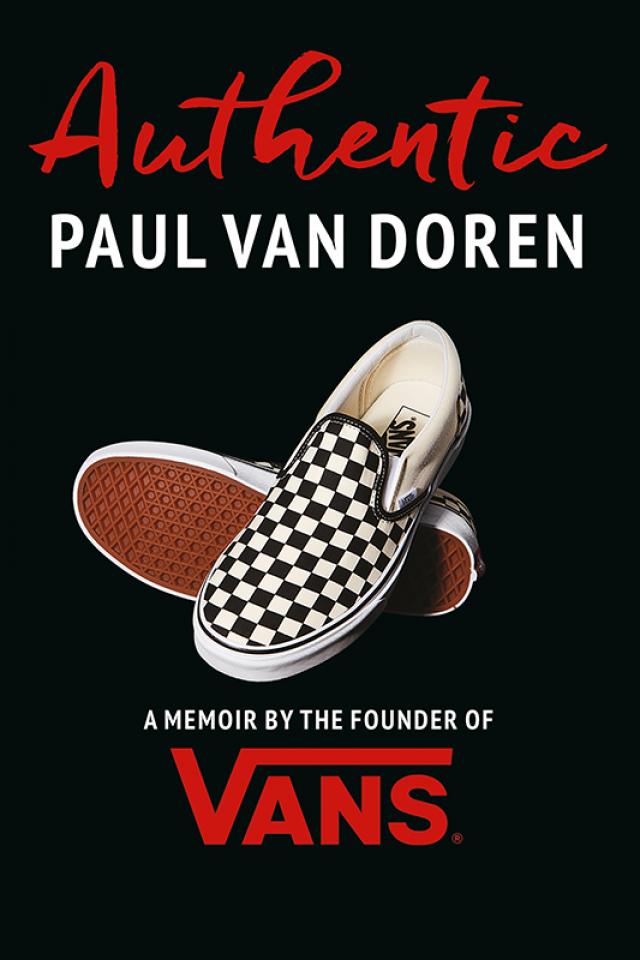
AUTHENTIC
Paul Van Doren
AUTHENTIC
Copyright © 2021 by Paul Van Doren
Cover design by Nicole Caputo
Cover photo by Jason Ulep
All rights reserved
No portion of this book may be reproduced, stored in a retrieval
system, or transmitted in any form by any means–electronic,
mechanical, photocopy, recording, or other–except for brief quotations
in printed reviews, without prior permission of the author
For information, contact Vertel Publishing at
www.thebookauthentic.com
2837 Rivers Avenue
Charleston, South Carolina 29405
First edition
Manufactured in the United States of America
1 3 5 7 9 10 8 6 4 2
Hardcover ISBN: 978-1-64112-024-1
eBook ISBN: 978-1-64112-025-8
Library of Congress Cataloging-in-Publication Data has been applied for
To family, who always come first
Contents
Forewordby Doug Palladini, Global Brand President, Vans
;Preface by Paul Van Doren
Chapter 1:Be Authentic
Chapter 2:The Education of an Entrepreneur
Chapter 3:Organize a System
Chapter 4:Respect the Workers
Chapter 5:Take the Reins
Chapter 6:Never Waste an Opportunity
Chapter 7:Listen to Your Customers
Chapter 8:Sell What You Believe In
Chapter 9:Go Off the Wall
Chapter 10:Get Out While You Still Have Your Sanity
Chapter 11:Shit Happens: Get On with It
Chapter 12:Embrace Change
Chapter 13:Get Back to Core Culture
Chapter 14:Surf the Waves
AfterwordDress in Overalls
Acknowledgments
Photo Credits
Foreword
M
y eyes fought to adjust to the dimly lit, Boston-area pizzeria—vinyl dinettes and a vintage cash register, frozen in time. “Lynwood—Since 1949,” I read from the logo on a sticky menu. I watched as a short, stocky man with a ruddy complexion and silver hair came into the space, screen door banging closed behind him. I had yet to meet Paul Van Doren, Vans’ founder, despite having worked for the brand he started for much of a decade at that point, and I honestly wasn’t sure what to expect.
As it turned out, Paul, or “PVD” as we often call him, wasn’t really sure what to expect, either. Living in Kentucky, with his horses, Paul and Vans had quite frankly grown apart and lost touch. Paul missing from our conversations had been a gap I was intent on closing—as Vans’ global marketing leader and big fan of legacy and its role in brand storytelling—which is why our entire global marketing leadership team was crammed into Lynwood on this particular evening. This was the Randolph, Massachusetts, pizza joint where Paul would take his family on Friday nights, after a long week of work overseeing shoe manufacturing at the nearby Randolph Rubber Company plant. Meeting here was part of my master plan to lure him back into the Vans’ fold.
Paul shuffled quietly up to a table and sat down next to his son Steve, our global brand ambassador and public face of the brand. Father and son were an interesting contrast in styles: Paul seemed to be understated and reserved. Steve was boisterous and gregarious. Paul didn’t come with any prepared remarks, so Steve waded in, carefully prompting and coaxing his father's memories. Paul's voice and energy rose viscerally with each response and, as his reticence fell away, so did his timidity. Several hours later, having held us rapt in his remembrances throughout the meal, our team had been taken on a truly remarkable journey of the American Dream, and Paul Van Doren was back.
Since that cathartic evening, Paul's presence, both literally and figuratively, has returned full strength to Vans. And our brand is better for it. With the American Dream on the ropes in our current caustic culture, Paul remains as resolute in his tenth decade as he was in any of the first nine: hard work, honesty, and caring for people are what yield success. The beauty lies in simplicity, so don’t overcomplicate things. Instead, focus on blocking and tackling, consistently, one day at a time. I found Paul's old-school mindset almost revolutionary in its utter lack of pretense, one of those “so old it's almost new again” ways of thinking about business. “The boss can grab a broom and sweep up just like the rest of ‘em” is the traditional, blue-collar kind of ethic that remains steadfast in Vans’ culture today.
Years later, as Paul and I moved cautiously through crowded shopping mall corridors and into a Vans store, his pace slowed to a stop, and I watched his face turn to a look of wonder as he took in his surroundings. Paul took hold of a display case, seeming to steady himself as he soaked in what his small family shoe brand had become. A small rack with a few shoeboxes leaning carefully against it had been replaced with hundreds of footwear styles, patterns, and colors on every wall. Apparel and accessories flowed through the space where none had existed before. And intelligently designed shelving, lighting, signage, and the like augmented the space and the products where once five-and-dime tchotchkes covered the bare walls.
“How many of these did you say there were now?” Paul asked.
“A couple thousand, globally,” I replied.
Paul shook his head as if trying to make sense of the “from” he created in 1966, the “to” we were living in now, and all of the space in between. He sold maybe a dozen pairs that first week, six decades prior. Now we were selling more than two million pairs a week. I tried to give Paul some space and let him wander on his own. I watched as he stepped gingerly around tables of flannels and chinos, past racks of socks and belts and shoelaces. But it wasn’t long before he found himself in front of the footwear wall, an imposing array of rubber, canvas, leather, and foam. He picked up shoe after shoe, running his deeply rutted fingers along the waffle patterns pressed into the rubber soles.
Eventually, Paul waved me over to where he was examining the white “foxing tape” sidewall of a Classic Slip-On not dissimilar to those he had first built decades before. “What do you see here?” Paul thrust the shoe at me as if to further emphasize the question.
“Right here.” He pointed to where the tape overlapped at the back of the heel. I took the shoe and ran my finger over the rubber step. “The tape overlap is a sign of this shoe being handmade. There isn’t a machine that can do what a good shoe builder can.”
Of course, Paul was right. Somewhere in the space between 1966 and 2016, between his one factory in Anaheim and our dozens of factories across Asia, between 12 pairs and 120 million, our manufacturing base had shifted from California to Asia, but the pride in hand-assembling every pair remained. Maybe the scale, the complexity of what Vans had become, was impossible to fully comprehend. But Paul could still pick up any pair of Vans sneakers, any day, anywhere, and see just how it was made a little better than the others. It wasn’t about that specific pair of shoes as much as it was about the approach, the attitude, the commitment to excellence. It was a classic Paul Van Doren teaching moment.
And one that I’ll never forget …
Doug Palladini
Global Brand President, Vans
Preface
M
y entire life, I never had one big idea. I like to think I woke up one day and figured out how to make the world's best canvas-and-rubber, waffle-soled deck shoes, how to distribute said shoes, and thus create the first vertically integrated tennis shoe company in the world; but the fact of it is, I could have been growing potatoes.
Actually, shoes have nothing to do with my success. What I’ve accomplished comes down to one thing: my knack for identifying and then solving problems. What I do better than anything else is cut out distractions. If a system isn’t working efficiently, I can see where it's jammed, eliminate the problem, and find a way to keep everything moving forward.
Everyone has something they naturally do better than anyone else—this happens to be mine, and I was lucky enough to have the opportunity to leverage it.
Then there's everything I learned by doing. Much of Vans’ early success was the happy result of hard work and creative troubleshooting. It helps that, at Vans, we used vulcanized rubber on the soles of our shoes. It helps that we identified retail spaces. It helps that we dialed in production like Lee Iacocca on his best day at Ford or Chrysler. It helps that we knew our customers, especially the skaters and the surfers and the moms. It helps that we cared about making a really good quality shoe at an affordable price, and to give exceptional customer service—always. It helps that I handed over the reins in 1980, when I got burned out, and was able to return in 1984 per an order from Judge Peter M. Elliott of the bankruptcy court in Santa Ana, California.
It also helps that we listened to trendsetters. My son, Stevie, perfectly articulates what we learned about expanding our business by working with kids on skateboards and surfboards: Listen to your customers, who will tell you what they want. If it's a checkerboard, if it's bright pinks and yellows, or if it happens to be dinosaurs or a skull and crossbones, listen to their two cents’ worth about colors and designs and what they think a graphic should look like on a shoe or a shirt. Pay attention to the people using your product—or even better, work with them to create something completely new.
It also helps that we were tenacious. I’ve learned that what makes a successful entrepreneur is the same thing that makes a good skateboarder or good surfer: you need grit and determination to get b ack up every time you’re knocked off the board.
In the world of successful entrepreneurs, I’m not Phil Knight. I’m not Yvon Chouinard. It never occurred to me to disappear for a month here and there to pursue other interests. I’m not Bill Gates or Jeff Bezos or Mark Zuckerberg or Elon Musk. My guess is, I’m unlike any other founding CEO. I’m just a small business owner who did well and found the right partners. I’m the guy who held tight to the kitchen faucet until he could hand over the valve.
When I was approached to write a business memoir, I wondered how I could explain my life as a series of tidy lessons learned. Eventually, I realized that what I would offer to other businessmen and women is less formula and more whatever the opposite of formula is—let's call it fluidity. I don’t know where to draw the line between the business me and the personal me. It's something I failed to teach my children. The lines have always been so damned blurred.
The way I’ve run my business is the way I’ve lived my life. The one thing that has always been sacred to me—and this goes for life as much as business—is just this: always try to do what's right.
I learned early on that what's right is right and what's wrong is wrong. If you put thought into something and do what's right every single time, you won’t be far off from doing the best you can—the best any of us can.
Many of my guiding principles are equally simple, and they’ve served me equally well. Don’t sit still or rest on your laurels. Do the work—don’t just look on as others do it. My famous credo: get your hands dirty. If a young entrepreneur came to me today and asked how to start a company, I would say right off the bat: know what goes into making what you’re selling. If you sell from a place of total confidence in the quality down to the details, you will succeed.
I also say find honorable people to be your partners, work with creative people, and be fair. Be kind. Give a shit about how you treat people and be aware of how your actions might disturb or distress them. In other words, don’t be a jerk. Stand up for others. Until our last breath, we can do something good for someone else.
The fact is, no one gets anywhere alone; and in the end, what a person makes isn’t as important as how and with whom he or she makes it. I always said that Vans is a people company that makes shoes—not the other way around.
I’ve had one hell of a ride, and in telling my story, I tell Vans’; but that isn’t the whole of it. Without my kids, Vans wouldn’t exist. They, alongside their mother, Dolly, and me, got their hands dirty and worked for tacos; my in-laws dropped everything to help us launch. Bob Cohen listened to me when I was a sixteen-year-old supply boy at the Randolph Rubber Company. Serge D’Elia handed me a parachute when Bob left me no options but to jump, and Gordon Lee and my brother Jimmy took that flying leap alongside me. My debt to each is as obvious as the words on this page.
I’ve experienced a lot of joy; I am also all of what I’ve lost. While my kids, their kids, and their kids’ kids are healthy, I outlived my wife Drena and a number of peers. I’ve lost brothers, business partners, colleagues, and friends. Everyone I knew from my shoemaking days is gone.
Suffice it to say, no one is around to fact-check most of what I offer herein. You’ll have to take my word for it, and as you read, keep in mind I wrote from memory, recreating situations from the near and far past as best I could.
Five decades after I started the Van Doren Rubber Company, our brand is associated with “expressive creators,” the artists, musicians, skaters, and surfers—the trendsetters, the ones who go their own way.
I could not be prouder, because that's how I always did things, too.
Paul Van Doren
AUTHENTIC
CHAPTER ONE
Be Authentic
A
ll I needed to know about making canvas shoes I learned at the Randolph Rubber Company in Randolph, Massachusetts. My mother got me my first job at Randy's, as we called it, as a service boy (a kind of runner or material handler) when I was sixteen. I went on to spend the first twenty years of my career learning the trade.
Soon after I had been promoted to a supervisory position at Randy's, my boss Bob Cohen invited me to attend the industry's semiannual trade show. The Boston Shoe Travelers Association show was the place where retailers scout lines and preorder shoes for the following season. In the shoe manufacturing world, this was the big time.
I was still very low in the pecking order, so the invite was contingent on the fact that while the “suits” wined, dined, and entertained each other, I would do the grunt labor of setting up, arranging, organizing, and breaking down the display booth. I didn’t mind skipping the cocktail events and industry dinner, not a bit; I was just excited to witness deals being made. Besides, my boss, whose father owned Randy's, had a Buick convertible. Traveling together meant I would have a chance to drive it.
That first industry trip turned out to be the most instructive in my twenty years at Randy's. I learned a few things about the business, of course, but more important, I had one of the defining experiences of my career—and it didn’t have anything to do with shoes.
At the time, Randy's wasn’t exactly the darling on the shoe block, but given the company's longstanding relationship with Keds, they were a minor player. Back then, Keds and Converse were the heaviest hitters, and we were far from being a Keds or a Converse.
The first day went about as I expected, with buyers from different department stores and retail outlets perusing our wares, along with aisle after aisle of our competitors’. Bob chatted up folks while I tidied things.
One of the people Bob made a point of talking to was a major buyer named Harry, who worked for a big retailer that represented more than 50 percent of Randy's business. He and Bob left at some point in the afternoon, and when they returned much later, when it was time for Bob to collect me and drive home, Harry was sideways. Bob was tipsy toasted, but Harry was smashed.
If Bob wanted to call it a day and hit the road, he didn’t show it, and Harry certainly didn’t seem as if he was ready to part ways, either. He stumbled around a while, then he got right up in Bob's face and slurred, “Bob, I want you to go out to Boston Common and catch me a pigeon.”
Bob might have been baffled, but he replied good-naturedly, “Come on, Harry, let's do something else, something more fun.”
Harry was not having it; there was no convincing him otherwise. “Damn it, son,” Harry insisted. “I want you to catch me a pigeon.”
I was stumped. These men were roundabout the same age. In present company, no one was anybody's son. Besides, surely Harry was joking. Surely, he’d come to his senses or, barring that, Bob would knock some sense into him.
And yet the next thing I knew, I was leaning on a lamppost on Tremont Street, watching a man I admired nearly as much as my father falling over himself trying to catch a pigeon.
My reaction was visceral. I was disgusted. Maybe Randy's would have lost half their profits that year if Bob had told Harry to take a flying leap; we’ll never know. Clearly, Bob wasn’t about to jeopardize the account. He was intimidated.
Try as I might, I could not put myself in Bob's position. I could not imagine letting some jerk humiliate me. It wouldn’t have mattered to me that Harry bought more than half the shoes Randy's made. He could have bought every last one. I would never let one person have that sort of control over me.
In fact, damn it, there had to be a better way. Why were we depending on a handful of buyers, anyway? Someday, someway, somehow, I would figure out a way to get rid of the middlemen. Because no amount of business would ever be worth my integrity.
I will never forget that hour in Boston Common watching Bob Cohen chase pigeons. Not only did it help me figure out what sort of folks I wanted to work with, but it crystallized for me what I would be willing to work my ass off to avoid. I would never work with jerks.
I also credit that experience with giving me the courage, many years later, to start my own company. By then I had worked my way up to run Randy's most successful factory. I had learned the essentials of shoe manufacturing and a thing or two about business.






