

Saloon justice, p.1
Saloon Justice, page 1


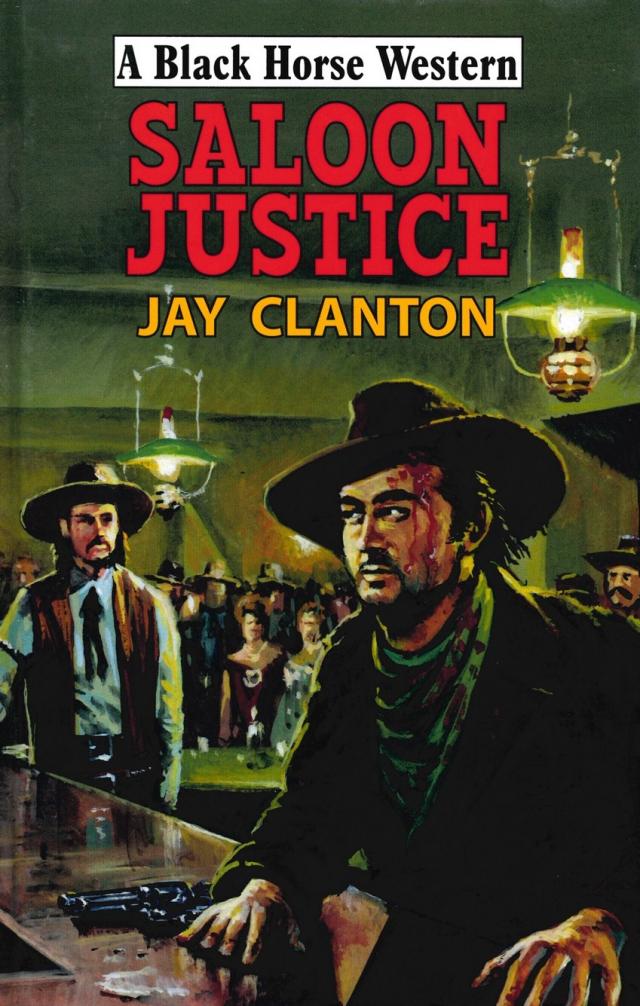
Saloon Justice
After a row with his fiancée, young lawyer Jerry Freeman leaves New York and travels as far as his meagre savings will carry him. He ends up in the small Texas town of Mineral Springs, where Judge Clayton Singer, owner of the local saloon, runs the strangest court ever known in the history of the United States and nobody dare go against him.
Jerry is appointed Public Defender and soon becomes accepted in the little community. However, when he makes a poor judgment about one of his clients, Jerry ends up on the wrong side of the law himself and in peril of his life.
Saloon Justice
Jay Clanton
ROBERT HALE
© Jay Clanton 2014
First published in Great Britain 2014
ISBN 978-0-7198-2414-2
The Crowood Press
The Stable Block
Crowood Lane
Ramsbury
Marlborough
Wiltshire SN8 2HR
www.bhwesterns.com
This e-book first published in 2017
Robert Hale is an imprint of The Crowood Press
The right of Jay Clanton to be identified as author of this work has been asserted by him
in accordance with the Copyright, Designs and Patents Act 1988
Chapter 1
I’m never going back, thought Jerry Freeman, as he picked up his bag and left the train. Not ever. The town at which he had arrived was so small that there wasn’t even a proper railroad station, just a low wooden platform alongside the tracks. It was one of those places where you had to signal the driver of the train if you wanted to stop there. Still, this one horse Texas town was as far away from New York as Jerry had been able to get on the money that he had when he was buying the railroad ticket. He had changed at St Louis and now here he was in a town called, according to the sign, Mineral Springs – the best part of fifteen hundred miles from the girl he loved.
That last row had been just terrible and it was after that he had decided just to light out of town for good. It had been a cowardly and unmanly course of action to take, he knew that well enough. Still and all, there it was. There was little enough he could do about it at this late stage. Here he was, as far as his money could take him and no means at all of getting back to New York, even if he so desired.
The town itself began a hundred yards from the railroad tracks and so Jerry picked up his bag and started walking in that direction. The first building he came to, right there on the very edge of the settlement was a saloon called The Texas Rose. It was a smart enough place, with a veranda at the front. In addition to the name of the establishment, The Texas Rose, there were two more signs, one announcing that ice beer was to be had within, the other, and more prominent, giving folk to understand that Judge Clayton Singer, Notary Public, was connected to the place in some capacity. Wondering what to make of this, Jerry Freeman walked up the steps and entered The Texas Rose in search of a long, cold drink.
The place seemed crowded, considering that it was only half past two on a Monday afternoon. Jerry would have supposed that most people would be working at this time of day, but there must have been three dozen men crammed into the bar-room. He had to wait a spell to get served and the old barkeep was disposed to be chatty. ‘Stranger eh? Well you chose the right time to get here. Court Day, today. Hanging day too, if I ain’t mistook.’
‘Hanging? You mean somebody has been sentenced to death?’
‘Not yet they ain’t,’ chuckled the bar tender, amused at such naivety. ‘Wait till Clayton settles the business though. It’s a Mexican. He hates Mexicans.’
‘What’s that got to do with the case?’ asked Jerry curiously. The barman looked at him closely and with a certain amount of suspicion.
‘From out east are you? Yes, I thought as much. You’ll find we do things a bit differently round here, boy. You wait and see.’
When he had been served with his beer, which despite the advertisement outside the saloon was anything but ice cold, Jerry looked around the interior of the bar-room. It was crowded, smoky and dirty. Against one wall were two rows of chairs, one in front of the other, upon which sat twelve men. They all had glasses of liquor in their hands and half were smoking as well. What they were doing lined up like that was something of a mystery to Jerry. While he was puzzling over this, the old barkeep rapped smartly on the counter with an empty bottle and cried, ‘All be upstanding for his honour, Judge Singer.’
At first, Jerry thought that this must be some kind of joke. He looked round and saw that a grimy, unshaven and dishevelled-looking middle-aged man had emerged from a door behind the bar and that everybody, including the twelve men seated by the wall, was indeed standing up. ‘What the devil is this?’ muttered Jerry to himself.
The grubby and unkempt fellow walked across the room to where a chair had been placed on a raised dais or platform. He took his seat there and then announced in a harsh, rasping voice, ‘Court is now in session.’
Incredible as it might seem, this seedy little bar really did double as a courtroom. Jerry thought about the sign he had seen as he approached the building, with its reference to ‘Judge’ Clayton Singer. Why, he’d never heard of such a thing before in his life!
‘Let the prisoner be brought up,’ said the unappealing figure sitting on the platform. ‘An’ be quick about it! This here is eating into my business hours.’
In the courtrooms which Jerry had visited in New York, the command to ‘Bring up the prisoner’ really meant to produce him from the cells and lead him to the dock. In this court though, the instruction was obeyed literally. A trapdoor in the middle of the floor, which evidently led down to a cellar, was opened and a wretched-looking fellow hauled up. He had probably been confined in the darkness of the cellar for some little time, because he stood there blinking and screwing up his eyes, as though even the meagre amount of light to be found in this dingy room was painful to him.
‘Carlos Robles,’ announced the man whom Jerry now took to be Judge Singer. At the sound of his name, the man looked up hopefully. ‘This court finds you charged with a grave offence agin’ the dignity and peace o’ the sovereign State o’ Texas. To wit, a-rustlin’ o’ cattle. How d’you plead?’
The man who had been dragged out of the cellar seemed to understand that something was required of him, but clearly could not understand what was going on. He gabbled a few sentences in rapid and unintelligible Spanish.
Judge Singer waited until Robles had finished speaking and then, to Jerry’s utter amazement, responded by saying, ‘Court accepts your plea o’ guilty. Jury will now deliberate and if’n it brings in any sort o’ verdic’ short o’ hanging, it’ll be held in contempt. Gentlemen, what’s your verdict?’
Up to this point, Jerry Freeman had been spellbound by the sheer, improbable grotesqueness of the scene unfolding before him. Now he marched forward and said loudly and clearly, ‘What the hell is going on here?’
There was a deathly hush and Jerry was uncomfortably aware that every pair of eyes in the saloon were now turned upon him. Judge Singer was staring at him as though he had just found a cockroach in his dinner. He said, ‘Young fellow, you best approach the bench and tell me what you mean by int’ruptin’ the dignity of the court in this way. I’m more ’an half- minded to have you committed for contempt.’
When he was standing before Singer, the young man simply couldn’t bring himself to think of the man as ‘Judge’, that individual said, ‘Now speak out. Tell who ye are and what you wish to say.’
‘My name is Jerry Freeman and I am an Attorney at Law in New York City.’
In 1878, eleven years before Jerry Freeman fetched up in town and at a time when he was just a boy of twelve, The Texas Rose had been the only building of note among a little huddle of dwelling houses and barns which could scarcely be dignified even with the name of hamlet; let alone town. Then the railroad came, passing within a hundred yards of The Texas Rose and things began to change rapidly. At that time, Clayton Singer had not yet become a judge and was still only the owner of a saloon. The increased trade from railroad workers and passengers who visited his place for a drink while the locomotive was taking on water had the effect of making Singer the closest thing in those parts to a wealthy man.
Over the years following the arrival of the railroad, Mineral Springs began to grow. Because he owned the land between the saloon and the railroad tracks and wouldn’t let anybody build there, Singer was able to ensure that this development took place in such a way that his saloon was still the first building seen by thirsty passengers. The trains seldom halted for more than ten or fifteen minutes, time only for a man to run to the saloon, gulp down a drink and then return to his seat, before he was stranded in Mineral Springs. Singer charged a dollar for a bottle of beer, which was outrageous in itself. He also made sure that if anybody handed over a five or ten dollar bill, then he was in no hurry to provide them with the change, shouting, ‘In a minute, in a minute! There’s others as want servin’ too, you know.’ When the whistle blew, signifying that the train was about to depart, those thus cheated had a straight choice; to miss their train and be stranded in Mineral Springs or to write off their money to experience. Not one man ever chose to stay in The Texas Rose to argue out the case and so miss his train.
As the town grew, the need to maintain law and order also increased. At first, this was accomplished in an informal way by means of a vigilance committee headed by Clayton Singer. This group of citizens handed out beatings and carried out the occasional hanging. It was a rough a nd ready system, but ensured that the little town was never over-run with cardsharps, rustlers, thieves, rapists and other undesirable elements.
Times were changing though and in 1885 the men at the county seat decided that it was time that a Justice of the Peace was appointed to administer law in and around Mineral Springs. As head of the vigilance committee, Singer was the obvious man for the position and, after posting a thousand dollar bond, he was duly appointed Notary Public and Justice of the Peace for a vast tract of sparsely inhabited country surrounding Mineral Springs.
Clayton Singer had never found his lack of formal education any handicap in either running his saloon or maintaining law and order in the town of Mineral Springs. He didn’t expect to find it a drawback in his new role as Justice of the Peace either. From somewhere, he acquired an 1848 edition of The Revised Statutes of Texas and studied this at odd moments between serving drinks. Singer had a good memory and within a few months he was able to quote whole chunks of the law governing the State of Texas, or at least the law which had governed it almost forty years earlier. Within a year, ‘Judge’ – as he had taken to calling himself – Clayton Singer could recite nigh-on the whole of that book by heart.
In a sense, Singer was a very effective Justice of the Peace, because folk took great care to keep out of his courtroom which, as Jerry Freeman discovered when he arrived in the spring of 1889, was none other than the bar-room of The Texas Rose. In general, he was automatically prejudiced against any defendant who wasn’t both white and a former member of the Confederate army. This meant that Mexicans, Chinese, blacks, Indians and northerners were apt to receive a raw deal on Mondays, when the court was sitting.
The idiosyncratic way that Clayton Singer ran his court became known to outsiders and the newspapers in Shelby County took to sending reporters to The Texas Rose on Mondays. Some of their accounts were so fantastic and amusing that papers as far afield as Boston and New York would occasionally reprint them. Singer’s vocabulary and accent were always faithfully recorded. On Wednesday, September 3rd 1887, for instance, there was a fight between two men working on the new branch of the railroad, which was being constructed some five miles south of Mineral Springs. One of the men, a Chinese coolie called Ah Lok Tam, died of injuries which he received at the hands of the other participant in the brawl. The survivor ended up before Judge Singer, charged with murder. The September 18th, 1887 edition of The Shelby County Intelligencer and Agricultural Gazette carried the news of the trial.
Amazing Judgment in Mineral Springs
Murder Trial
Regular readers of our newspaper will not be unduly surprised to learn that the most well-known luminary of the law in our own corner of the state has once again been making headlines with his highly individual way of dispensing justice in the town of Mineral Springs. Magistrate Singer, who in addition to administering justice keeps the town’s saloon, had to sit in judgment on a railroad worker called Thomas Dexter. Dexter was accused of killing Ah Lok Tam, a laundry man who, claimed the defendant, had insulted him. The man was arrested and brought before Singer in his saloon, which serves on Mondays also as the local courthouse. Singer listened to the evidence, given by the accused himself, and then proceeded to turn the pages of a woefully outdated copy of the Revised Statutes. ‘This here book, which is a Texas law book,’ announced his honour, ‘says that hommyside is th’ killin’ of a human, male or female. They is many kinds of hommyside – murder, manslaughter, plain hommyside, negligent hommyside, justifiable hommyside an’ praiseworthy hommyside. They is three kinds o’ humans – white men, negroes and Mexicans. It stan’s to reason thet if a Chinym’n was human, killin’ of him would come under th’ head of praiseworthy hommyside. The pris’ner is discharged on condition that he pays f’r havin’ th’ Chinee buried.
This then was the sort of man whom the young attorney found himself standing before, after having interrupted what was apparently a capital case of stock theft.
Clayton Singer peered at the young man intently.
‘Attorney, hey?’ he asked, in a tone calculated to suggest that he was not overly enamoured of the breed. ‘You practiced law in a courtroom?’
‘Yes, sir. I mean, your honour.’
‘Well, I s’pose you’ll be creating if we hang this thief without due process. You want to represent him?’
‘What, now?’
‘Yes,’ said Singer testily, ‘of course now. I want my cellar back. I got other things to do with it than fill it up with Mexican bandits. You want the job? Yes or no?’
‘Yes,’ said Jerry slowly. ‘Yes, I’ll undertake his defence.’
‘Well then, get on with it. We ain’t got all day.’
Jerry thought for a space and then said, ‘You say that this man Robles is charged with the theft of cattle? Is the owner present here today?’
Judge Singer said, ‘Jack Martin, that’d be you. Step up now and say your piece.’
A shifty and disreputable looking man shuffled to the front of the room and stood near Jerry. ‘Well,’ said Judge Singer, ‘let’s have it man. I know the story, but this boy don’t.’
‘Some o’ my steers was stole. . . .’ began Martin, but Jerry Freeman cut in at once.
‘Objection. This witness has not been sworn in.’
‘What then?’ said the judge irritably. ‘You think he’d dare tell a heap o’ lies in my court? I don’t think it for a moment. Carry on.’
‘A man is on trial for his life,’ said Jerry hotly, ‘and you’d have him convicted on testimony not given on oath?’
Whatever effect the young attorney was having upon the judge, it was plain as a pikestaff that the men in the saloon were enjoying the show immensely. One or two muttered remarks such as, ‘Boy’s right. Let’s hear him take his oath.’
The room not being too large, these observations were audible to the bench and eventually Singer gave in and called for his Bible to be fetched in from the back where it was usually kept. After Jack Martin had sworn by almighty God that the evidence he gave would be the truth, the whole truth and nothing but the truth, Jerry Freeman commenced his cross-examination.
‘You say that some of your steers were stolen,’ said Jerry. ‘How do you know that they were stolen and did not wander off of their own accord?’
This question caused the witness to furrow his brow and think long and carefully. At length, he said, ‘That greaser was found nigh to ’em. . . .’
‘That isn’t what I asked,’ said the young attorney. ‘I asked how you knew that they had been stolen.’
‘M’ neighbour, Isaac Potter, came by my place an’ said as they’d seized a Mexican who’d taken some of my brand.’
‘Do you mean to tell me that you hadn’t missed the animals?’
The man shrugged, as though this was matter of little account. ‘First I know of it is where Potter came by and tells me that three o’ my steers had been found an’ this fellow looked to be makin’ off with ’em.’
‘In short,’ said Jerry, ‘You had no reason to believe that your cattle had been stolen, other than the word of your neighbour?’
‘I guess. . . .’
‘I’m not asking you to guess, Mr Martin. May I remind you that you are on oath? Did you have any cause to believe that your cattle had been stolen?’
‘No.’
‘Your honour,’ said Jerry Freeman. ‘I call Isaac Potter.’
It appeared that Isaac Potter was not in court and nobody had any clear notion of where he was to be found that day. At last, somebody suggested that he was involved in the well-digging a little way from the town. A couple of men volunteered to ride out and bring him to The Texas Rose. Judge Singer agreed to adjourn the case until the witness could be fetched and sworn in.
There was a great deal of lively conversation once the court was officially suspended and the bar opened again. Nobody present had ever seen the like and this trial was certainly providing more entertainment than was usual. From being an open and shut hanging matter, men were now laying bets as to the possibility of the Mexican going free.






