

The bride of death, p.1
The Bride of Death, page 1


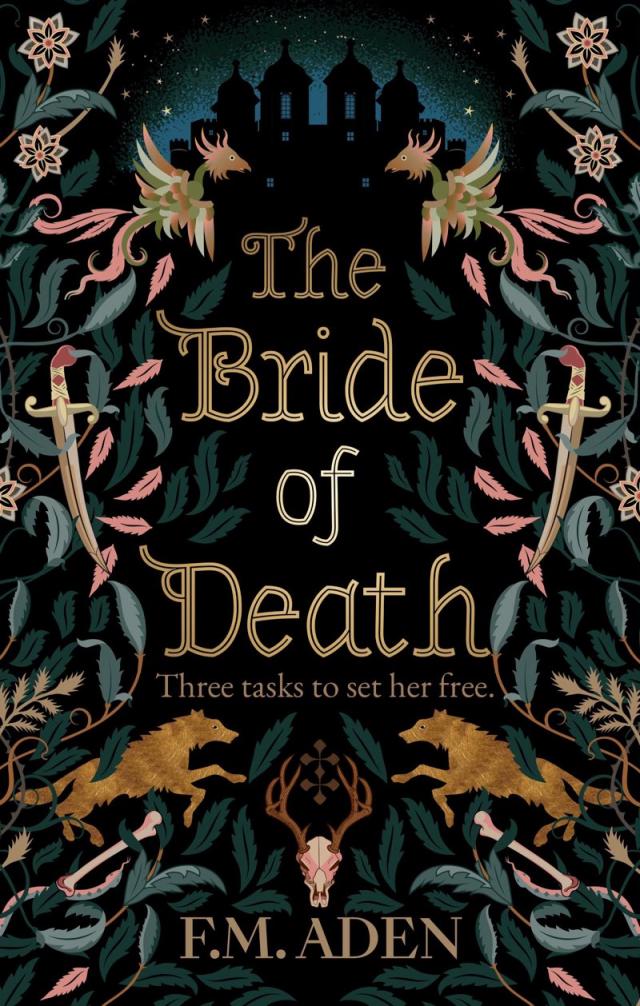
Contents
I. Girlhood
1. The Black Wolf
2. The Girl Who Dreamed of Death
3. The Servants of the Devil
4. The Malicious House Spirit
5. The Year of Hardship
6. The Demon of Mount Ida
7. The Possession of a Dear Friend
8. A Bargain with the Lord of Death
II. Underworld
9. The Feast
10. The Princes of the Underworld
11. The Three Tasks
12. The Bone Forest
13. An Unlikely Ally
14. Susula the Sea Daughter
15. The Coveted Egg
16. The Trickster Fairy
17. Spring & Winter
18. A Thief of Magic
19. A Binding Promise
20. The Weight of a Soul
21. The Little Lamb
22. The Second Trial
23. The Cold Shall Not Touch You
24. The Secrets of Death
25. Zerryn the Wise
26. The Cruel Forest Witch
27. A Boy Who Loved a Girl
28. Vasily’s Home
29. A Vicious Rendition of a Musical
30. A Trip to the Above
31. Nameday
III. Death
32. A Husband of Light and a Husband of Darkness
33. A Nightmare Tangled in a Dream
34. The Silver Sword
35. The Battle
36. Let Us Watch Them Burn
37. Erlik
Epilogue
Glossary
Acknowledgments
About the Author
The Bride of Death is a work of fiction. Names, characters, places and incidents are the products of the author’s imagination or are used factiously. Any resemblance to actual events, locales or persons, living or dead, is entirely coincidental.
Copyright 2024 by F.M. Aden
Cover copyright 2024 by Northern Light Press
All rights reserved.
No part of this publication may be reproduced, stored in a retrieval system or transmitted, in any form or by any means, without the prior permission in writing of the author, nor be otherwise circulated in any form of binding or cover other than that in which it is published and without a similar condition including this condition being imposed on the subsequent purchaser.
ISBN: 978-1-7389631-4-0 (e-book edition)
ISBN: 978-1-7389631-3-3 (trade paperback edition)
Northern Light Press
Toronto, Ontario
To those of you who dream about a tall figure in a dark cloak beckoning you to some unknown place and knowing in your heart that you would follow. This one is for you.
Part One
Girlhood
The Black Wolf
It was the start of Midwinter and in a small, crooked house in western Anatolia, a little girl counted her bread.
Zerryn always counted her food before she ate to make sure the spirits didn’t rob her when she was distracted. Her stomach clenched in hunger, but still she counted the unleavened dough that made her yufka. The house of Özdemir was lit with thin, fingerlike candles, and shadows covered her father’s face where he sat at the head of the table, stroking the ends of his dark beard. On his right sat Derya, Zerryn’s nursemaid, who had looked after her ever since her mother’s lungs had collapsed from a weeks-long fever. Her plump form was folded tight on her cushion, and her rough fingers tore the edges of her bread with a viciousness that was almost predatory. Her face was as round as an apple with supple cheeks and a nose as sharp as a blade, as if it didn’t quite fit.
Outside, nesting in the black pine tree, was a crow that watched her with its beaded eyes protruding like little walnuts. It opened its wide beak and cawed as if it were speaking to her.
“Do not play with your food, Zerryn,” Derya chided. “You know what happens to little girls who do not eat.”
“The black wolf will eat them,” she whispered.
At eight years old, Zerryn knew that there was magic in the world. A soft, silent magic that existed like a film between their world and the Underworld. And sometimes creatures broke through the curtains and got lost in the woodlands. It was why Zerryn avoided the woods. Especially the thick, frost-covered woods that surrounded their home. They called it the Dead Woods. There was rarely any whistling of crickets or the howling sound of a wolf from the Dead Woods. And when her father would dive into its moss-covered arms to hunt, all he’d find were carcasses.
Hakan Özdemir frowned at the sight of his only child. He turned to Derya with a sharp gaze.
“You fill the girl with so many tales, she is half afraid of her shadow,” he said. Zerryn didn’t look at them as they spoke. Her eyes were stuck to the window as if she saw something they did not. She had been like that recently, he’d noticed. Her head stuffed full of rubbish and false tales; she could barely answer to her own name.
“Stories are the food of the mind,” Derya said. “We live so far from the village that there are no children for her to play with. She enjoys my tales, and there is no harm in it.”
Sometimes he imagined that Derya had been here all along, that she had been made with the bones of their home and she had simply revealed herself to them because she knew that Zerryn needed her.
Eylül, his wife, had passed away a fortnight ago, and he had been trapped in the despairing hands of grief, drowning his sorrows in ale and neglecting Zerryn, who dutifully sat by her dead mother day and night. He had known he had failed her when he found her one night sleeping atop the grave, fingers clenched tight into the dirt, as if she held her mother’s hand. With her dark hair sprawled around her like a carpet woven of silk. His heart had stopped, and for one terrible moment, he wondered if she were dead as well.
But then Derya had arrived as a gift from the old gods, with her firm fingers and discipline. She kneaded their bread made their stew and stitched the torn fabric of their clothes. But most importantly, she nurtured Zerryn, breathing life into the empty girl.
Hakan lived a quiet life in the woods with his three milk cows, four weak-legged goats, and harvested fruit. And on Wednesdays and Fridays, he sold a basket of a dozen eggs at the market. During winter he was always paid better. Hungry mouths led to generous fingers. Derya often sewed cloaks that were sold at market as well, but she asked that the money be put into Zerryn’s dowry, always thinking of the little girl.
It was Derya’s one request that Hakan ask no questions, and in return she would serve the Özdemir family for as long as she lived. So, Hakan never asked how she knew so many stories or why there had been no footprints in the wet mud the day she arrived. Or how she had found them so far from the village. Or why the wind had whistled so terribly before she knocked thrice on their wooden door.
Hakan knew that she had either been sent as a tide of blessing or as an omen of despair.
And he had never questioned which one it could be.
Zerryn was a wild girl with a mane of hair that coiled like a pit of serpents; a slim, almost foxlike face; and big curious eyes so green they seemed to reflect the forest. The villagers had always called her beautiful but strange. As if her beauty were tainted with something unnamable, twisted, and crooked like a broken bone that had been set the wrong way. The villagers often gave them a wide berth. The Özdemirs were not people who joined them for prayer or their village folk dances. So, the villagers had no care for them. They coexisted like thread rotating on a spinning wheel, creaking under the pressure of their unspoken words.
Zerryn had never cared that she was odd. She spent so much time in her head that she could never keep track of time, and she certainly could not keep track of the villagers’ opinions. The hours slipped away like rain pouring down the windowpane. Slowly and languidly, months passed her at a time, and when clarity finally hit, she felt as though she had awoken from a great slumber.
It was late that night when Zerryn crept out of her bedroom to play in her mother’s old garden. Her father had buried her mother between the winter jasmines and the crocus to purify her soul, he said, and to grant her peace. Zerryn had always found it quite beautiful. She imagined her mother tangled in brambles and vines like a trapped princess.
Zerryn danced under the moonlight. She liked to dance and pretend that she was performing before a great crowd. The curls of her hair fanned around her, drifting like a bridal veil. Garden tulips were tucked between each of her little fingers, soil caked beneath the crescents of her nails. She could feel the eyes of a thousand creatures watching her. Some joined her, lacing their ghostly palms together and intertwining their translucent bodies in grotesque mimics of couples. Others watched; lips curled beneath unseen fangs. She did not hear them, but their hisses escaped them all the same. She knew they were the Unseen. They were the jinn. The ones Derya had warned her to always seek protection from.
“Dance, little lamb,” they whispered. “The black wolf awaits.”
A grim black cat watched her from the shadows. Its eyes narrowed in malice, and when he struck out at her legs, Zerryn could do little to stop herself from toppling over like an untethered cypress tree. The roots of her limbs collapsed in a tangle, her legs slipped out from under her, and she fell and fell and fell.
Zerryn didn’t know how long it was until she heard a sickening crack and felt the blinding touch of pain and then darkness. So much darkness, it suffocated her. It slithered between her nostrils and the gape of her mouth.
Zerryn knew of deat
Her eyes adjusted to the abyss, and Zerryn made her way toward the gates, where she knew the iron warriors stood. The dark sons and daughters were said to be the offspring of the Lord of Death and had been sent to guide her past the Lake of Tears and to the halls of Erlik Khan. They wore matching black kaftans with thick fur hoods pulled over their heads. And all the boys looked like one, and all the girls looked like one, so you could scarcely tell one from the other. But all of them were achingly beautiful.
Just as she was to cross into the Underworld, a slip of shadow slithered between the cracks of the earth. At the sight of it, the demon-eyed soldiers fell to their knees in greeting, heads bowed low, long hair scraping the uneven earth.
“We have brought you a soul, Baba,” they chimed, like toy soldiers. Zerryn found it oddly charming. Her eyes lifted to the murky form that took a distinctly human shape, with arms and legs and a head and four cavernous holes that would have held eyes if it had any.
Zerryn trembled, but she didn’t look away. Not when the bundle of shadow crept closer and the cold of it dampened her bones. The breath that escaped her lips was foggy, and she imagined her lips were tinged blue. But the shivers that wracked her body were not entirely caused by the cold. Some small voice within her told her that something terrible was going to happen and that she had little power to stop it.
“I wish to go home,” she whispered.
“You are a long way from home, little lamb,” the voice hummed. It sounded like power, old power, the kind that lived buried deep in the ground. The kind spun of darkness and cloaked in the drapes of death.
“I am no lamb,” Zerryn said, and she was certainly not a little lamb.
If shadows could smile, this one did.
“We shall see.”
The Girl Who Dreamed of Death
It had been late spring when Derya died.
Before she had died, Zerryn had felt in her bones that something wretched would come for her nursemaid. And for the first time in her life, she had dreamed of someone’s death. She saw Derya walking through the Dead Woods, following the haunting sound of goblet drums played by the long, pale fingers of death. The trails of her old, maidenly nightgown soaked up the dirt and twigs with each step till she was fully submerged in the river. The moon slithered up her wrinkled skin, and her flesh ballooned with river water, lungs popping under the weight of the pressure. A strange, eerie smile hung on her face as she sank deeper into its cold embrace.
Zerryn wondered when she had become this way, so entwined with the icy fingers of death that at times she wondered if it were her companion. It must have been the morning she had awakened with one of her green eyes turned a startling black that reminded her of the crows she had once seen joyfully pecking at a dead cow. Their beaks had repeatedly stabbed the bloated corpse with vicious kisses. Derya had simply stared at her that morning, two years ago, and when she saw her eyes, she simply shuddered and began to quickly sweep the floor. Her Baba had frowned, fine wrinkles digging into his mouth.
“Are you ill?” he asked. “Can you see, child?”
“Perfectly well,” Zerryn said.
And nobody had spoken of it after that.
For weeks, Zerryn had sat by Derya–in the sweltering kitchen as she tore the bones out of their venison and pounded her garlic and herbs with her wooden stick–afraid that some unnamed harm would befall her. As she churned and boiled milk and fermented cabbages, sweat beaded her forehead and her dark hair remained twisted in its signature braid, swaying down to her hip.
“Do you believe in dreams, Aunt Derya?” she asked. “Terrible dreams that chill you.”
“Wicked dreams are from the jinn,” Derya said. “Evil spirits will whisper to you, but to trust them is a grave sin.”
“I dream of death,” she whispered.
“Hush, child,” Derya scolded. “To speak of it is a curse as well.”
Zerryn had kicked her feet out beneath her. The tangles of her skirt whipped across her ankles, and her brown feet peeked out from underneath.
“Perhaps your father is right. Stories have ruined you,” Derya said. “I think you should go to bed tonight with nothing but warm milk and your imagination to keep you company!”
“No,” Zerryn groaned. She adored Derya’s strange stories. The other night she had told her a story of a she-wolf who had come across a child and nursed it to health. He would drink night and day from her teat, and when he grew older, he impregnated the she-wolf and gave birth to cubs with tangled human legs and soft fur. Zerryn had found the tale rather off-putting but enjoyable. As many tales as Derya told her of princes and curses, she also told her of mythical beings and darkness and demons.
“You never tell me stories of him,” Zerryn said. “Of Erlik Khan.”
It was strange that Derya never spoke of him. There were so many stories of the Lord of Death. Yet she never told her any.
“Pass me the goat cheese,” she demanded.
Zerryn picked up the block of wet cheese. “Will you tell me of him?”
“I cannot, child,” she said. “I spoke a bargain long before you were born, and I promised to never speak a word of the devil. I promised to never sway you in any manner.”
Derya turned to face her. She bent on her old knees that creaked like a door whose hinges had not been oiled in some time. Her frail fingers stroked her brow, and Zerryn hadn’t realized how old she had gotten. Her father said Derya hadn’t aged a day since she arrived, so Zerryn assumed that she had always been old. But now she seemed older.
“I will say this, my child,” she said. “Someday he shall call for you, and you will have little choice but to answer.”
And that following morning, Derya was found dead in the river in the middle of the cursed woods, floating atop the water with an eerie smile on her face.
Hakan was worried for his little girl. The death of Derya had struck her most cruelly. She had been young when Eylül died, but she was not as young now. She ate and slept, but she did not play or laugh or dream. She had grown thinner, bones peeking from beneath her skin like the rising sun between the clouds. He wrote a letter that night to Eylül’s mother. She had never accepted their marriage in the past because he had been a humble farmer and Eylül had come from wealth. Her mother, Pinar, was a merchant whom fortune had smiled down upon, and she had been despondent when she’d received word of their nuptials.
His hands were as desperate as a supplicant standing before the gods as he wrote his letter.
Dearest Mother,
I am writing to you to plead for your help. Our Zerryn has been ill since the passing of Derya, her maid. She does not speak and rarely eats. I fear I have isolated her far from the other children, and she has not a single woman to soothe her and wipe the tears I see so keenly in her eyes. I beg you to come visit. It will brighten her day, and she has not seen you since Eylül passed. I do not wish for the child to be in pain anymore. And if you love her as you love Eylül, please come visit.






