

A gem of a murder, p.1
A Gem of a Murder, page 1


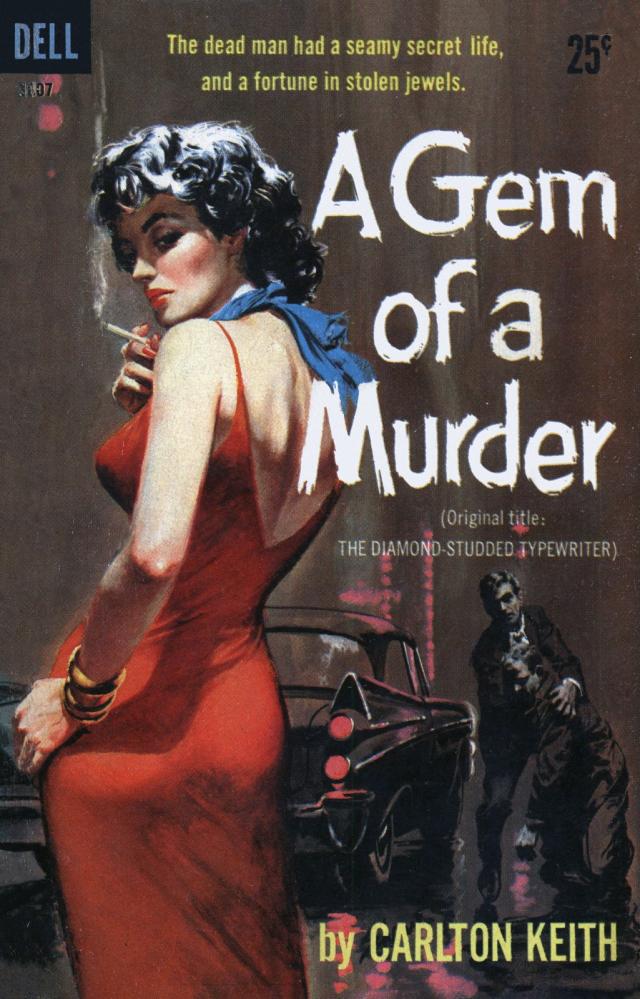
They were all after the missing diamonds. But which one had killed for the privilege?
The wife he had deserted twenty years ago, a fading Southern belle who was vaguely firm that “he must have left some money somewhere”…
“Maximillian Duckworth,” the little man with the big henchmen—and his own covetous ideas about the dead man’s secret life…
The daughter he never acknowledged, who had never seen him alive—and had little reason to mourn him dead…
The redhead who went after big generous gentlemen with small expensive trinkets—dead or alive…
CARLTON KEITH
A Gem of a Murder
original title: The Diamond-Studded Typewriter
Published by
DELL PUBLISHING CO., INC.
750 Third Avenue
New York 17, N.Y.
© Copyright, 1958, by Keith Robertson
All rights reserved
This book was originally published under the title
of The Diamond-Studded Typewriter
by The Macmillan Company
Reprinted by arrangement with
The Macmillan Company
New York, N.Y.
Designed and produced by
Western Printing & Lithographing Company
First Dell printing—November, 1959
Printed in U.S.A.
Table of Contents
Chapter One
Chapter Two
Chapter Three
Chapter Jour
Chapter Five
Chapter Six
Chapter Seven
Chapter Eight
Chapter Nine
Chapter Ten
Chapter Eleven
Chapter Twelve
Chapter Thirteen
Chapter Fourteen
Chapter Fifteen
Chapter Sixteen
Chapter Seventeen
Chapter Eighteen
Chapter Nineteen
Chapter Twenty
Chapter Twenty-One
Keith Robertson
Chapter one
James Garvin watched the elevator door close behind his departing visitor and then walked briskly back to his apartment. He closed the door behind him, snapped the spring lock, and slipped the end of the chain lock in place. He walked into the large living room, glanced at the closed Venetian blinds, and continued on across the room toward the desk in the far corner. As he passed the coffee table he looked at the tall, almost untouched, glass of gin and tonic but did not pause. He was a methodical man and believed in business before pleasure. Sitting down at the desk, he opened a drawer and removed a number of envelopes of various sizes, shades, and shapes. From his inside coat pocket he brought out a thick bundle of currency. He removed the rubber band and without bothering to count the amount began separating the sheaf of bills into a series of piles on the desk top. There were thousand-dollar bills, five-hundred-dollar bills, hundreds, and fifties, but Garvin paid no attention to the denomination. He parceled the money out into eight piles as though dealing a deck of cards.
When he had finished, he picked up one pile and felt of its bulk judiciously. Nodding approval, he carefully inserted the bills into a white envelope and sealed it. He placed this envelope in turn in one of the larger ones and sealed that. Turning the sealed envelope over, he carefully addressed it. He went through the same procedure with the other seven piles of bills, printing the address on some and changing his style of penmanship on others to make them look different. When they were all addressed he reached in the drawer again and found a small pocket postal scale. He weighed each letter to make certain that it was not overweight and put a stamp in the upper right-hand corner.
After a glance into the hall he walked to the elevator and dropped the letters one by one down the mail chute. Then he returned to his apartment and locked the door as before. A faint smile of satisfaction crossed his otherwise impassive face as he once more entered the living room. He glanced around, located the paper-backed book that he had been reading, sat down in an easy chair near the coffee table, and reached for his drink. As he did so, the telephone rang. Garvin raised one eyebrow, put down his book, and walked to the telephone stand.
“James Garvin speaking.”
As he listened a flash of annoyance crossed his face.
“This is rather inconvenient,” he said, none of the annoyance showing in his voice. “I had hoped to leave the city in the morning.”
He listened again for a moment and then said, “No, I’m sorry, Miss Tremaine. As I explained this afternoon, I was instructed to make delivery to no one but Mr. Lanham. I feel obligated to carry out my instructions.”
The voice on the other end of the wire was not so circumspect about hiding its annoyance. Garvin shrugged his shoulders slightly. “As you say then, I’ll just have to wait until Friday evening.”
He replaced the phone and stood by the phone scowling for a moment. “Damn nuisance,” he said aloud to himself; then briskly he went into the bedroom and opened the closet door. He reached into the far end of the small dark closet and found the handle of a portable typewriter.
Taking the case into the living room, he placed it on the coffee table. He snapped open the lock, swung the upper part of the case upward and back. As he did so he bumped it against the glass of gin and tonic, knocking it over. The contents poured out on the glass-topped table and on the thick carpet. Garvin gave an exasperated snort and quickly shifted the typewriter to a chair before it could get wet. He hurried to the bathroom, returned with a towel and carefully mopped up the spilled drink. He put the soaking towel into an empty clothes hamper in the bathroom and returned to his typewriter.
From a coat pocket he produced a small metal object about the size and shape of a fountain pen. He unscrewed the cap from this, dumping several drills and blades into the palm of his hand. Selecting a small screwdriver blade, he attached it to the end of the handle. He took the roller from the portable typewriter and removed a plate at the right end of the platen, revealing a hollow interior. The roller was a steel cylinder covered by a layer of rubber.
Garvin placed the parts of the platen on the coffee table and reached in his inside coat pocket. He removed a small black silk bundle and a tiny bag made of cotton flannel. He unrolled the black silk to reveal a magnificent diamond necklace which seemed wreathed in cold blue flames of light.
His glance was not even interested. He was merely checking to see that the necklace was still there. He rerolled the bundle, tied it with two strings, and stuffed it into the hollow typewriter roller. Next he inserted his fingers in the tiny flannel bag and pulled out one solitary unmounted diamond. He held it between his thumb and forefinger and examined it critically. It was a beautiful stone with a faint reddish cast. He nodded with approval at the deep rich light of the many faceted stone and replaced it in its bag. This, too, he inserted in the hollow typewriter roller and began reassembling the parts.
When the typewriter was together once more he carried it back to its place in the bedroom closet. Picking up his empty glass from the coffee table, he passed through the swinging door into the kitchen and mixed himself another gin and tonic. With this in his hand he returned to the living room and once more picked up his book.
Garvin was a quiet reader. For at least forty-five minutes he read without stirring, other than to lift his glass to his lips occasionally for a small sip. Suddenly he raised his eyes and glanced toward the kitchen door. He put his book down carefully on the arm of his chair and listened intently. Motionless and quiet, he sat in the big chair listening. Then slowly, he got to his feet and moved across the thick carpet toward the kitchen. He passed through the big double doorway into the entrance hall and turned to face the kitchen door when suddenly it opened.
“You!” Garvin exclaimed.
The only reply was the sullen sound of a silenced revolver. A look of consternation and unbelief spread over Garvin’s usually impassive face. His jaws sagged and his knees buckled. He pitched forward on the carpet and was still.
Chapter two
The sign on the corridor door said “Monroe and Green, Examiners of Questioned Documents.” On the other side of the door was a large room with one wall lined with file cabinets, a stenographer’s desk, a settee and two easy chairs, and a small table on which there were a number of magazines. Near the desk a door led to a connecting office. The room was obviously both a secretarial office and a reception room, and Miss Mabel Potts was both secretary and receptionist.
Mabel Potts was very fond of her employer, Mr. Jeffrey Green, and she considered him the most eligible bachelor in New York City. Being a realist, she did not waste time with any romantic thoughts of herself. She was tall, horsefaced, gangly, and twenty years his senior, so she did the next best thing to falling in love with him. She did her utmost to keep him from falling for anyone else. She had been secretary to Mr. Monroe when Jeffrey Green joined the firm ten years before as a glorified messenger boy. The fact that he was now the entire firm made no difference. He was a naive country boy who still needed her protection from New York’s smart and attractive but designing women. No one, in Mabel Potts’ opinion, no matter how many years removed from South Dakota, could be a match for the big city’s predatory females.
When Alice Anthony entered the office, Mabel Potts took one look and mentally buckled on her shield and picked up her lance. Miss Anthony was small, not more than five feet four inches tall even with her very high heels, but her figure was trim and attractive with firm hi gh breasts and invitingly rounded hips. She had a pert face, curly dark hair, and alert dark eyes. After a brief pause just inside the door she walked briskly toward Mabel Potts’ desk.
“My name is Alice Anthony and I would like to see Mr. Green,” she announced crisply.
Mabel Potts looked at the visitor’s smart tailored blue suit disapprovingly. Alice Anthony looked both efficient and determined, a type that was almost as dangerous as the soft helpless breed of female.
“Do you have an appointment?” Mabel asked coldly.
“No.”
Mabel Potts pulled a blank from her desk drawer. “Your name?” she asked.
“Alice Anthony.”
“Address?”
“I don’t think that will be necessary,” Alice Anthony said pleasantly. “Mr. Green will probably be able to take care of my problem in a few minutes.”
Mabel Potts made a decisive question mark in the space reserved for the address, went into the adjoining office and closed the door behind her. Jeffrey Green sat at his desk, tipped back in his chair with his long legs stretched out and his feet on one corner of the desk top. He was a tall lanky redhead in his early thirties with a long good-natured face and a somewhat beaklike nose which was covered with freckles. His dark brown eyes looked slightly amused and sleepy.
“There’s a Miss Alice Anthony outside to see you,” Mabel Potts announced.
Jeffrey Green took his feet off the desk, straightened his tie, and sat erect.
“What about?”
“I don’t know. She didn’t give me her address so I didn’t bother asking her her business. I dare say it has something to do with questioned documents,” she said dryly.
“Look like money?” Jeff asked.
“Not particularly,”’ Mabel Potts replied. “But I suppose you’ll find the case interesting.”
Jeff grinned. “A doll, eh? Send her in.”
Alice Anthony sat down facing Jeff Green’s desk. He leaned back in his chair and gazed at her appreciatively. “What can I do for you, Miss Anthony?” he asked.
“I have two documents,” she replied, coming directly to the point. She opened her purse. “I would like to know if they were written by the same man.”
Jeff reached out a long arm and took the two pieces of paper which she offered. One was a yellowed letter, written some twenty years before, which started out with the salutation “Dear Hermione.” The other was little more than a note and was without salutation. It was apparently addressed to an apartment manager or superintendent and contained some instructions about repairing a leaky faucet and a living room which the writer wanted repainted. The writer had signed both near the bottom of the sheet and both signatures had been cut off with a scissors.
Jeff Green raised one eyebrow quizzically. “The signature’s been removed,” he observed in his lazy drawl. “Yes,” replied Miss Anthony, offering no explanation. Jeff’s second eyebrow went up to match the first. “There’s been a considerable lapse of time between the letter and this note. A person’s handwriting does change during the course of years, but certain characteristics tend to remain the same. How old is the writer?”
“Approximately thirty-five on the first and fifty-five when the second was written,” Miss Anthony replied promptly. “Why?”
“Well, he was definitely adult in both cases and his handwriting habits should have been rather well formed,” Jeff replied. “Do you have any more samples that I could examine?”
“Of the early penmanship, yes,” Alice Anthony replied. “That note is the only sample though in the last twenty years.”
“Well, it’s not much to go on,” Jeff observed. “What is your objective? Do you want to establish in court that the writer of these two was the same man? Because getting up and swearing in court and just giving you my opinion are two entirely different matters.”
“I merely want an opinion,” Miss Anthony said. “An expert’s opinion.”
“Very well,” said Jeff. “I imagine I can give it to you in three or four days.”
“Must it take that long? I’d like to know now.”
“A thorough comparison takes time,” Jeff explained. “I usually photograph the documents, enlarge them, compare each letter very carefully, make overlays so that I can lay one specimen of penmanship on top of another, and sometimes test the paper and the ink.”
“Couldn’t you just look at it for a few minutes and tell me what you think?” Alice Anthony insisted.
“I could, but I want you to understand that it would simply be a hasty opinion. The essence of my business is being thorough and painstaking. However, if all you want is a hasty examination and an equally hasty opinion, I can give it to you.”
“That’s what I want.”
“If you’ll excuse me for a few minutes, I’d like to take this into the laboratory,” Jeff said.
He rose and walked through the partition into the laboratory and dark room which occupied one half of his large office. He proceeded to make photostats of both pieces of paper and then took them to a drawing board in the corner of the room where he examined both documents carefully for almost fifteen minutes. He looked at both sides of the paper, held the letters up to the light, and examined the penmanship through a magnifying glass. Finally he appeared satisfied. He returned to his desk, closing the laboratory door behind him.
“Now this is not a court opinion,” he warned as he sat down, “but in my opinion these were written by the same man.”
Alice Anthony held out a hand for the two letters. “Thank you. That was what I wanted to know.”
“Nothing else?”
“No, that’s all. How much do I owe you, Mr. Green?” she asked in a businesslike voice.
“Fifty dollars,” Jeff replied casually.
Alice Anthony’s hand paused halfway to her purse. “Fifty dollars?” she asked somewhat weakly.
“That’s correct,” Jeff said smiling pleasantly: “Fifty dollars is my minimum fee, Miss Anthony.”
“Isn’t that rather stiff,” she asked, glancing at her watch, “for less than half an hour of your time?”
“I don’t think so. You see, you’re not paying for my time exactly. Miss Anthony, but for many years of experience. There are only a very few people in the United States who are experts in matters such as these. When you want an expert’s opinion you have to pay for it.”
“I see,” Miss Anthony replied. She opened her purse, counted out four tens, a five, and five ones, which she placed on his desk.
Jeff smiled, picked up the bills, and stuffed them carelessly in a side pocket of his coat. Again he glanced appreciatively at Alice Anthony’s trim figure. “It’s practically noon,” he said. “Why don’t we have lunch together, Miss Anthony?”
“Thank you, no. I have enough left to buy my lunch,” she replied rather acidly.
Jeff grinned good-naturedly. He liked girls with spirit. “Well, there was your chance to get some of it back,” he said, shrugging his broad shoulders.
“I have no intention of overeating simply because you overcharge,” Alice Anthony said firmly, getting to her feet.
Jeff’s grin slipped into a half leer. “You don’t have to overeat. In fact, we could both keep a close eye on your figure.”
“I’m sure an expert like you has many more lucrative things to do,” Alice Anthony said. “Good day, Mr. Green.” Jeff watched her walk out of the office, her high heels beating a brisk tattoo on the asphalt tile floor. He sighed regretfully and went into the outer office.
“Make out a file for Miss Alice Anthony,” he said. “Comparison of documents, fifty dollars, paid in full.”
“Shall I put it in the closed cases file?” Mabel asked, a note of satisfaction in her voice.
“I suppose so,” Jeff replied. He walked to the window and stood looking down at the street below. As he watched he saw Alice Anthony appear at the corner, wait for the light to change, then cross to the opposite side. She entered the drugstore on the corner and disappeared from view.
“Poor gal,” he observed. “She’s reduced to eating a sandwich and a malted milk at the corner drugstore.”
“Humph!” said Mabel Potts. “She’s not drinking malted milks. She has to watch her figure too closely for that. That girl could be stocky with very little trouble.”






